
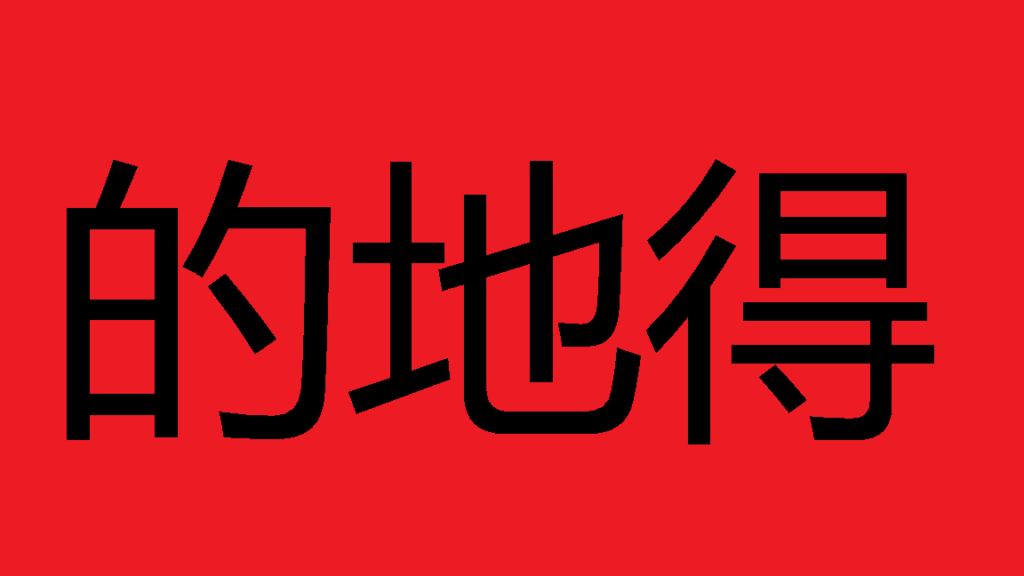
There are three de character in Chinese which often confuse learners. My intention is to explain these in detail. In summary the three Chinese de characters are:
|
|
|
|
I have also covered the use of the
Table of Contents
How to use 的 in Chinese
somebody/somethings +
Let’s look at some simple examples:
| Chinese | English |
|
wǒ de bāo |
my bag |
|
tā de shū |
her book |
|
tāmen de chē |
their car |
All of the above are simple pronouns, however this doesn’t have to be the case.
adjective +
Some examples:
| Chinese | English |
|
hěn rè de shuǐ |
very hot water |
|
tài chǎo de háizi |
too noisy kids |
|
zuì kuài de chē |
the fastest car |
|
huángsè de huā |
yellow flower |
This is unlike English where we do not use possession so often. To take the last example, we never say “yellow’s flower” or “hot’s water” in English
You can also use 的 with a verb, this follows the familiar formula:
verb +
|
|
zuò fàn de rén |
The person who cooks |
|
|
kāichē de rén |
The person who drives |
|
|
chànggē de nǚrén |
The woman who sings |
The above is really the equivalent of saying in English “the <noun> that <verb>”, or to be more specific, “The person/thing or thing who does something”, where “something” is the verb.
When can 的 de be left off or omitted?
There are several situations where you can simply leave 的 off completely:
Situation 1: You do not need to use
For example:
| English | Correct | 的 not required |
| My mother |
wǒ māmā |
wǒ de māmā |
| My father |
wǒ bàba |
wǒ de bàba |
| My friend |
wǒ péngyǒu |
wǒ de péngyǒu |
| My teacher |
wǒ lǎoshī |
wǒ de lǎoshī |
Situation 2: 的 can be dropped is in the case of a single character adjective:
| English | Correct | 的 not required |
| Fast car |
kuài chē |
kuài de chē |
| Cold water |
lěng shuǐ |
lěng de shuǐ |
When the subject of a sentence can be removed from a 的 sentence
The subject of a sentence can be removed if it is understood from context. Dropping words or details is common in Mandarin common where context is understood.
For example:
| Question | Correct – with 的 | Also correct – with the subject |
|
zhè shì shéi de chē? Whose car is this? |
zhè shì wáng lǎoshī de chē This is the teacher Wang’s |
zhè shì wáng lǎoshī de This is teacher Wang’s car |
|
nǐ yào qù shéi de jiā? Whose house do you want to go to? |
wǒ yào qù wáng de I want to go to Wang’s |
wǒ yào qù wáng de jiā I want to go to Wang’s house |
You do not have to drop the subject, however doing so will make your Chinese sound more authentic and reduces unnecessary repetition. In English we similarly drop words, so for example if you were asked: “whose car is this?” you could respond “this car is Mr Wang’s” or “this is Mr Wang’s car”, however you most likely would just reply “it’s Mr Wang’s”.
As you can see Chinese and English are similar in this respect.
How to use 的 multiple times in a sentence
You are able to combined 的 multiple times in a sentence, as usual here are some examples:
| Chinese | English |
|
wǒ de lǎopó de chē |
My wife’s car |
|
wǒ qùnián de hěn xǐhuān de lǚxíng |
My last years enjoyable holiday |
This again shows the flexibility of
Similar to English, order doesn’t matter when listing attributes of a noun, that is attributes of a person, place or thing. you for example the following are equivalent:
| Original Chinese Sentence | Order reversed |
|
hěn gāo de hěn shuài de nánrén this/those very tall, very handsome guy(s) |
hěn shuài de hěn gāo de nánrén this/those very handsome, very tall guy(s) |
|
nàgè hěn dà de hěn hóng de qiú the very large, very red ball |
Nàgè hěn hóng de hěn dà de qiú the very red, very large ball |
The above only applies to listing attributes of a noun, and not possession. For example:
| Correct | Incorrect |
|
zuótiān dezhōngwén de bàozhǐ yesterday’s Chinese language newspaper |
zhōngwén de zuótiān de bàozhǐ Chinese language yesterday’s newspaper |
|
wǒ de tóngshì de péngyǒu de wánjù my colleague’s son’s toy |
wǒ de tóngshì de wánjù de péngyǒu my colleague’s toy’s son |
As you can see from the above examples, reversing the order doesn’t make sense when using
Using 的 multiple times with quantities
It is important that any numbers be included at the start of the setnence prior to the multiple 的 in a sentence, so for example
| English | Correct | Incorrect |
| Those two tall, handsome guy |
|
|
| Those ten large pink birds |
|
|
English is somewhat similar but less strict, so for example we would probably say “those two tall, handsome guys” instead of “those tall, handsome two guys” or “those ten large pink birds” rather than “those large pink ten birds”.
How to use 地 in Chinese
地 is the equivalent of “-ly” in English
For example:
| Chinese | English |
|
tā hěn kuài dì kāichē |
She quickly drove |
|
tā màn man de shuō |
He slowly spoke |
There are a few important rules to remember when using
- Because 地 is used to add the equivalent of ‘-ly’ this means it is being used with adjectives e.g.
- quick becomes quickly
- slow becomes slowly
- 地 should be used with a two syllable word (adjective), you can do this by either repeating the single character character or add a degree to the word. To repeat my previous two examples:
| English | Correct | Incorrect |
| She quickly drove |
tā hěn kuài dì kāichē |
tā kuài de kāichē |
| He slowly spoke |
tā màn man de shuō |
tā màn de shuō |
How to use 得 in Chinese
As always, I prefer examples:
| Chinese | English |
|
tā pá dé hǎo |
She climbs well |
|
tāmen zuò fàn de bù hǎo |
He doesn’t cook well |
|
tā shuō dé màn |
He talks slowly |
Note: when I wrote the above on the computer using pinyin input, the computer wrote these as
The formula could be summarised as follows:
action verb +
Where:
- action verb examples are speaks, drives, climbs, walks, talks, etc.
-
adjective describes the action such as fast, slow, good (well), bad
If you want to add intensity to the above, you can insert this in fron of the adjective.
|
tā shuō dé tài màn |
He talks too slowly |
|
tāmen zuò fàn de zhēn bù hǎo |
He really doesn’t cook well |
|
tā pá de hěn hǎo |
She climbs very well |
|
tā kāi dé bǐjiào kuài |
She drives comparatively fast |
You can also use
| Question | Answer |
|
tā shuō dé zěnme me yàng How does he speak? |
tā shuō dé tài màn He talks too slowly |
|
tāmen zuò fàn de hào chī ma? IS his cooking tasty? |
tāmen zuò fàn de zhēn bù hǎo He really doesn’t cook well |
|
tā pá de zěnme yàng How is her climbing (ability)? |
tā pá de hěn hǎo She climbs very well |
|
tā kāi de kuài háishì mǎn? Does she drive fast or slow? |
tā kāi dé bǐjiào kuài She drives comparatively fast |
Using 得 to express possibility
得 can be used to indicate the possibility. Again this is best demonstrated by some examples
| Chinese | English |
|
tā chī dé wán |
he can eat it all |
|
tā zuò dé hǎo |
She can do it well |
|
nǐ kàn dé wán |
you can finish reading it |
|
wǒ xǐ dé gānjìng |
I can wipe it clean |
The formula here is as follows:
verb +
But what if you wanted to say something wasn’t possible? In this case you replace 得 with 不. Strictly this doesn’t use 得, however I am stating this for completeness:
| Chinese | English |
|
tā chī bù wán |
he cannot eat it all |
|
tā zuò bù hǎo |
she cannot do it well |
|
nǐ kàn bù wán |
I cannot finish reading it |
|
wǒ xǐ bù gānjìng |
I cannot wipe it clean |
Here the formula is:
verb +
Don’t confused 得 (de) with 得 (dei)
It is important not to confused the two pronunciations of
-
得 pronounced as “de” is used to explain how an action was performed, as I’ve already discussed above -
得 pronounced as “děi” and means must for example:我 得 买 蔬 菜 (wǒ dé mǎi shūcài) “I must by vegetables”
There shouldn’t be opportunity to confused these as the correct 得 should be obvious from the context.
How to use shi de (是的) in Chinese
The
To use
| With 是的 | Without 是的 | ||
| Chinese | English | Chinese | English |
|
|
He went to the hospital last month |
|
He went to the hospital last month |
|
|
Where did he through that ball? |
|
Where did he through the ball? |
|
|
With whom did he go on holiday? |
|
Who did he go on holiday with? |
As you can see from the above examples, the
The 的 in 是的 can also be placed after the verb rather than at the end of the sentence, so modifying the previous examples:
| 的 at the end of the sentence | 的 after the veb | |
| Chinese | Chinese | English |
|
|
|
He went to the hospital last month |
|
|
|
Where did he through that ball? |
|
|
|
With whom did he go on holiday? |
There are exemptions to moving 的 after the verb, specifically where the object of the sentence is a pronoun (for example him, her, they, us, etc) the 的 needs to be placed at the end of the sentence.
| Correct | Incorrect | English |
|
wǒ shì měitiān doū cháoxiào tā de |
wǒ shì měitiān dū cháoxiào de tā |
I tease him every day |
|
nǐ shì wèishéme dǎ tā de |
nǐ shì wèishéme dǎ di tā |
Why did you hit him? |
Negative sentences with 是的
Only 不 can be used with
| Correct | Incorrect | English |
|
|
|
I did not buy this book at the bookshop |
|
|
|
this book is not the biggest |
When 是 can be ommitted from 是的
When using the
Examples of positive sentences:
| With 是 (Correct) |
Without 是 (Also correct) |
English |
|
|
|
I bought this book at the bookshop |
|
|
|
this book is the biggest |
|
|
|
They came from where? |
Based on the above examples you can see how you can’t use
Conclusion
Wrapping it up, knowing which de to use comes with experience. I recommend mentally focusing on how to use de and not which character corresponds to the it’s specific use. To recap the use of de is
- possession: The ball is mine
这 个 球 是 我 的 - -ly equivalent: He ran quickly
他 很 快 地 开 车 - possibility:
他 说 得 快 - as emphasise:
你 是 在 哪 里 买 的 买 这 本 书